Showing posts with label players I worshipped. Show all posts

Tuesday, 21 January 2014

55. Paul Scholes


Signed from: Youth team
Debut: 2-1 win vs Port Vale (League Cup tie, scored twice), September 21st 1994
League Record: 404 games (+95 as sub), 107 goals
Sold to: Retired in the Summer of 2013

Ah, how we can laugh now. Youngsters may not know of the hoo-ha surrounding the debut of Paul Scholes: Fergie essentially decided to use the League Cup to blood younger players, in part due to the fact we had, in 1994/95, qualified for the Champions League group stage for the first time. This meant six extra games for the first teamers, though the “three foreigner” rule meant our first foray led to embarrassment in Barcelona and Gothenburg.

Therefore, with the first team stretched, the League Cup was what give way and the Boss decided to use it blood younger players. At the time, pundits moaned about United “cheating the paying fans” but in hindsight, how many of those that paid for the first Port Vale game boast about seeing the debut of the finest English player of his generation?

Short, asthmatic and (as a youth) topped with a crop of bright ginger hair, if Paul Scholes looked like a footballer it was more in the midfield-terrier style of a previous North Manchester-born legend - Nobby Stiles.  However, “the Ginger Prince” was born with an uncanny football brain that gifted him a superb range of passing and an ability to time his runs into the box to score vital goals. As for tackling… well, everyone has their kryptonite.

Initially playing as a centre-forward, by 1997, he had moved back to the centre midfield role, his superb range of passing and vision becoming a crucial part of our play. By 1999, Scholes and Roy Keane were doubtless the best midfield combination in the country and drove United to the Champions League final – Paul scoring a vital goal at the San Siro to get us past Inter Milan in the Quarter Finals. Bookings in the Semis against Juventus saw both miss out on the final, but Scholesy would finally get his medal nine years later, sealing our path to the final with a winning goal against Barcelona.

On the international stage, he was initially a success – Kevin Keegan was a huge fan. However, by the start of the new century, the pressure to play a system that featured Steven Gerrard and Frank Lampard (both of whom enjoyed the limelight) saw our man shunted out to the left wing by Sven-Goran Erikkson. It was a joke of a compromise, albeit one opposition teams were thankful for, seeing as it put England’s most dangerous player in a relatively harmless position. After the 2004 European Championships, he’d had enough and asked to not be considered for selection again. There was calls for him to be brought back for the 2010 World Cup, and Fabio Cappello was apparently keen, but Scholes decided he’d rather spend the summer at home in Oldham.

Though initially retiring in the summer of 2011, he came back in January 2012, a decision which would prove decisive to one young Frenchman who felt his deserved his chance in the first team and wasn’t happy to see the veteran get there instead. He played a final season, though his powers were clearly very much on the wane, before quitting for good at the end of 2012/13, another Championship medal in the bag.

It was a privilege to have seen the man play football.

Sunday, 4 November 2012

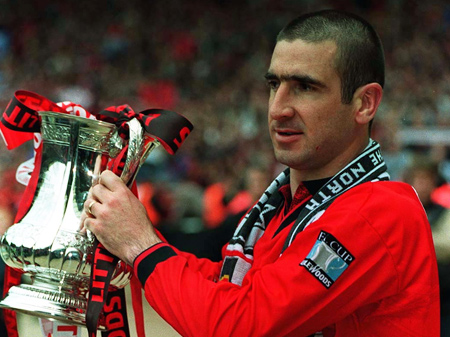
49. Eric Cantona


Signed from: Leeds United (£1,200,000), November 1992
Debut: 2-1 win vs Manchester City (as sub), December 6th 1992
League Record: 142 games (+1 as sub), 64 goals
Sold to: Retired, summer of 1997

The beginning of time, for this fan. Recently, one Red Issue columnist commented on one of our current players praying before kick off by saying "there’s only one God round here, and his name is Eric". Damn right. 

It’s strange to think that in early 1992, Eric Cantona was almost washed up. Though a French international, his temper had alienated him from several clubs in his homeland. Insulted by Sheffield Wednesday manager Trevor Francis’ request for a “trial”, he instead went to Leeds United, playing a minor (though subsequently exaggerated) role in their 1992 title win. 

The Yorkshire fans took to Eric quickly – perhaps enjoying a bit of exotic flair alongside the likes of Lee Chapman and Chris Fairclough.  He began the next season with a bang, scoring a hat trick in the Charity Shield against Liverpool and another triple (the first in the Premier League) against Spurs. But all was not well – Cantona’s individualism not mixing well with the rigid long ball game favoured by Howard Wilkinson.
Then came a fateful phone call in December 1992. Leeds contacted United about buying Denis Irwin (laughable, given they let him go for nothing in 1986), an obvious non-starter. However, either Alex Ferguson or United chairman Martin Edwards asked about Cantona – the word came back a deal might be on, and in quick time, United had a new forward. 

His impact was close to instant. At the time, we were struggling in the league, not scoring enough goals and looking like the failure to clinch the title the year before has sucked the fight from the players. Eric came along and galvanised everything. Linking well with Mark Hughes, he was given the chance to express himself with a freedom denied to him before. It's not an exaggeration to say things clicked almost overnight, as we won eight of the ten games following his debut.

More importantly, Manchester welcomed the man with open arms and he felt right at home. United fans recognise genius when we see it, and in Eric we knew we had someone with that ability to do the complete unexpected, a player to make you gasp in a way we hadn't seen since for some years. So highly did we (still do) value him, that he became "The King", a title only given once before, to Denis Law. As much as his ability was his attitude - one of his team-mates described him as "collar turned up, back straight, chest stuck out, he glided into the arena as if he owned the fucking place". He was unlike most footballers, living in a modest semi-detached house, taking an interest in art and cinema and capable of conversations beyond the usual "over the moon" variety.

In the 1993/94 season, he got even better, scoring vital goals as we held onto the title and won the FA Cup as well - Eric scoring two penalties in our 4-0 smashing of Chelsea. Our team that season has gone down in some legend to representing the peak of attacking football in the Fergie years: with Giggs, Sharpe and Kanchelskis running riot on the wings, both scoring and providing many goals. 

The next year seemed to be more of the same, until the famous night at Selhurst Park, when after being the subject of rough treatment from Crystal Palace defender Richard Shaw, Eric lashed out and was sent off by the referee. Trudging off the field, a Palace fan elected to charge down the stand shouting abuse only to be met with a flying kick from the King. For this, he was banned for nine months and United's season resulted in zilch. 

It was a strange time for us, and when Hughes, Ince and Kanchelskis were sold off that summer, some of us questioned Alex Ferguson's sanity. What we also didn't know at the time was that Eric was feeling fed up and almost ready to quit: it took a visit from Fergie to Paris to convince him to return to Manchester. 

And how glad we would be that he did. Made captain of a team where the likes of Gary Neville, Nicky Butt and David Beckham were now regulars, he was a strong influence and led from example: at the climax of the campaign we had a run where we seemed to win most games 1-0 with the goal from Eric. He repeated this trick in the cup final, slamming in a late winner against Liverpool in a moment that won't be forgotten by reds anywhere. 

The next season, though we won the league again, he didn't seem quite himself. Perhaps at 31, he realised he wasn't at his peak anymore. His retirement that summer was a huge shock, but in hindsight I can only respect his decision. He'd fallen out of love with the game and wanted to go do all other things with his life. In four and a half years, he'd helped turn a club of under-achievers into the most dominant club in England. There have been players before and after who have had more talent, but very few have won the hearts of the fans as much as Eric. 

Nowadays, he’s continuing to develop his acting skills on stage and screen (including the brilliant Looking For Eric) and working towards getting New York Cosmos back off the ground. And he’s still the sexiest fucker who walks the Earth.

Wednesday, 18 April 2012

7. Bryan Robson

Signed from: West Bromwich Albion (£1,500,000), October 1981
Debut: 1-0 loss vs Tottenham Hotspur (League Cup tie), October 7th 1981
League Record: 326 games (+19 as sub), 74 goals
Sold to: Middlesbrough (free transfer), May 1994

What to say? The man was my hero for the first decade and a bit of my life: a giant in a number seven shirt, often needed to carry average United teams to unlikely victories and also determined to throw his body in all manner of danger to the detriment of his own health.

His influence on my childhood cannot be overstated: I wore New Balance boots because he did; I always wanted to wear the number seven shirt because he did and I always, always pretended to be him in the playground kickabouts. You could keep your Marco van Basten, Diego Maradona and John Barnes: Bryan was better then them all.

At the time we signed him, he was the most expensive player in British football – and would remain so until Liverpool paid £1.9 million for Peter Beardsley in 1987. Sir Matt Busby resigned from the board as he was so appalled by the sum, but that other legendary Scots manager Bill Shankly knew better, advising Ron Atkinson to spend whatever it took to bring him to Manchester. At the press conference to unveil Robbo, he was described by his new boss as “pure gold”. Never a truer word spoken. Within a year of signing, he had become club captain and main driving force.

In an era where success was scarce, Robson was the source of many our best moments: two goals in the replay of the 1983 FA Cup final against Brighton, which we won 4-0. Dominating Barcelona in the quarter-final of the next year’s European Cup Winners Cup, scoring twice in a 3-0 win that trumped their 2-0 first leg win and being carried off the pitch by joyous fans. His scousebusting piledriver in the 1985 FA Cup semi-final against a Liverpool team that were winning just about everything in sight at the time.

But then there were the injuries. When I was around nine or ten, I wrote about my hero for a school project and found a list of all the setbacks he’d been through due to his combative style, including breaking his leg three times in one year during the early part of his career at West Brom. These hit United hard: it’s a pretty safe bet that our title challenges in both 1983/84 and 1985/86 were derailed in large part to him being missing with injury.

The amount of times he could single-handedly drive us to victory when the rest of the team were struggling are innumerable. Alex Ferguson knew this too well: while he got rid of some of the big drinkers playing for us when he took over, he knew he had to tolerate Robson’s fondness for a few beers (showing his North-East roots there…) due to his being absolutely vital to us having any chance of winning anything.

I'm not sure if there had been anyone quite like him before, at least in English football: a midfielder capable of breaking up an opposition attack at one end of the field before charging forward to nod in a goal at the other. Players such as Paul Ince, Steven Gerrard and, of course, a certain Cork lad have all excelled at the role since, but Robson was the master: his goalscoring records for club and country were excellent, especially in his peak years.

In the days before Sky Soccer Saturday and the like, I would listen to the radio on a Saturday afternoon waiting for the teams to be read out, holding my breath for when they announced who was the United number seven. If it was Bryan Robson, then you felt we had a chance of winning. If it was anyone else, I’d feel my heart sink in anticipation of defeat as we’d be bullied and outfought by the likes of Wimbledon.

This wasn't just the case for United, either. The national team suffered too. Consider the 1986 World Cup, where his shoulder gave way in the second game. England, after a crap first two games, rallied and made the quarter-finals, where Argentina waited. As is well known, Diego Maradona used a helping hand to put his team one up before, minutes later, having a casual stroll through the England midfield and defence to give them a crucial two goal lead.

But go back and watch that goal from the start and see the complete ease with which Maradona gets past Peter Reid – there is no way on Earth a fit Bryan Robson would have allowed that. He’d have chased him down and booted the short-arsed genius twenty foot in the air if necessary, not fannied out from being scared of a booking.

In the 1990 World Cup in Italy, he was injured again, though it’s fair to say this allowed the young, emerging talents of David Platt and Paul Gascoigne to shine. All the same, you’d have preferred Robson as an option on the bench ahead of the more one-dimensional Steve McMahon. Plus he’d have taken a better penalty than Chris Waddle.

That was also the year he became the first player to lift the FA Cup three times, also scoring in the first game against Crystal Palace. Aged 33, the pressure on him was finally lifting as quality players like Paul Ince were brought in to drive the team from midfield. He was still a first choice when fit, though, and still had enough in the tank to set up both our goals in the Cup Winners Cup final in ’91.

But by the time of the Premiership years, his contribution was pretty limited and he was often kept back as an impact option on the bench. Happily, he played enough games to earn a well-deserved Premiership medal in 1993, lifting the trophy alongside Steve Bruce on a memorable night. He earned another the next season, being fit enough to play a bigger role in our success, including scoring a goal with his genitals in the FA Cup semi-final replay against Oldham. This give him an impressive record of scoring in that stage of the tournament all four times he played in it.

He was denied a fourth FA Cup winners’ medal by virtue of there only being allowed two outfield subs back then and not making the cut for the final. Fergie would later regret not picking him, especially as his long-time captain was set to leave that month to take charge of Middlesbrough, whom he would lead to promotion the following season, also featuring in plenty of games as a player too.

Despite that early success, his career in management has seen more downs than ups. In 2005, he somehow managed to keep his old club West Brom in the Premiership against all the odds, but was sacked the next season when the team failed to build on that high. More recently, following a stint in charge of the Thai national team and a (hopefully successful) fight against throat cancer, he’s been working in an ambassadorial role for United.

A giant of a player – if we’d had a fit young Bryan Robson in our midfield in either of the two Champions League final defeats to Barcelona, I reckon we’d have had a chance. He simply was that good.