Tuesday, 2 September 2014
68. Karel Poborsky
Signed from: Slavia Prague (£3,500,000), July 1996
Debut: 2-2 draw vs Everton, August 21st 1996
League Record: 18 games (+14 as sub), 5 goals
Sold to: Benfica (£2,460,000), July 1998
I’m sure hardly any United fans had a clue who this guy was prior to the 1996 European Championships. There, the Czech scored a goal that got replayed countless times as his nation made it to the final, beaten in extra time by the Germans. It was enough to convince Fergie to stump up the cash on what surely must have been a transfer that was "taking a punt" rather than well-planned out.
In hindsight, he was a puzzling addition. As a right-winger, he was in competition with David Beckham, who had had a solid first full season the year before. Then, on the first day of 1996/97, young Dave scored from the halfway line at Wimbledon, a moment which helped propel him to superstardom.
Karel, meanwhile, was less prone to such spectacular moments, though if nothing else he was faster than Beckham. Despite a well-taken goal in our 4-0 spanking of Leeds, he never really established a regular spot. His ridiculous hair style perhaps didn't help endear him to the crowd too – a factor to which Maurone Fellani can relate to.
In his second season, his chances of a game dropped and he was let go to Benfica, to non-existent mourning from most supporters. He clearly wasn't that bad, as he subsequently went on to enjoy a lengthy career in Italy, Portugal and back in his homeland. 118 caps for the Czech Republic isn't too shabby either!
67. Ronny Johnsen
Signed from: Besiktas (£1,200,000), Summer of 1996
Debut: 3-0 win vs Wimbledon (as sub), August 17th 1996
League Record: 85 games (+14 as sub), 7 goals
Sold to: released on a free transfer, Summer of 2002
At the time, to me at least, an unknown when we signed him. Having started in his native Norway, a short spell in Turkey preceded his move to us, by which time he was already established in the national team.
And a fine signing he turned out to be. Calm, tough enough to hack the English game but refined enough to be able to use the ball at his feet, he would become a firm favourite with the fans.
Though signed (presumably) as Fergie continued the search to replace Steve Bruce (he had left the summer Ronny signed), he occasionally filled in at midfield, playing an absolute blinder in that role in our 4-0 drubbing of Porto in 1997. The Portuguese side were considered a tough draw, but a barnstorming performance saw us through to the semi-finals.
A championship medal capped off a good first season, but he never quite managed that level of consistency again, in the main part due to injuries. He still managed to do his bit in the Treble season, though, starting in the Champions League final. Subsequent seasons saw injury problems limit his appearances and he was eventually let go on a free. He managed to get a contract at Aston Villa, playing fairly regularly for two years before a short spell at Newcastle. Drifting back home, he enjoyed a few more years playing before retiring at the end of the 2008 season.
A fine player, who rarely let anyone down, the kind that often make up vital cogs in a championship winning team.
Friday, 21 February 2014
66. Jordi Cruyff
Signed from: Barcelona (£1,400,000), August 1996
Debut: 3-0 win vs Wimbledon, August 17th 1996
League Record: 15 games (+19 as sub), 8 goals
Sold to: Alaves (free transfer), June 2000
If Darren Ferguson had problems having the boss as his old man, how about the pressure of your dad being one of the greatest players of all time? That was the shadow Jordi Cruyff had to always deal with throughout his playing career.
An attacking midfielder, he was born in Holland despite his dad being a huge Barcelona star at the time, though the middle name he went by (his first name is Johan) was a name from Catalonia. Jordi got his break under his pop at Barca, and did good enough to get in the Netherlands squad for the 1996 European Championships. Unfortunately for him, the tournament was a nightmare for a Dutch squad blighted by in-fighting, summed up by a 4-1 kicking from England. To compound the pain, Cruyff Senior was sacked by Barcelona and Jordi quickly realised he wouldn't fit in the new regime.
Jordi was a decent player blighted by injuries at United that prevented him from ever being a regular in the first team. It must have frustrating for him, as he was often shifted our wide left as cover for Ryan Giggs, a role he clearly wasn't suited to. After his first season, appearances became more limited, hard going for a player who clearly had enough talent to do better. A loan spell back to Celta Vigo in 1999 signposted where his future was, and he eventually returned to Spain when his contract expired.
Later, he would have spells in Ukraine and Maltra before moving into coaching. He's currently General Manager of Israeli team Maccabi Tel Aviv.
Thursday, 20 February 2014
65. William Prunier
Signed from: On trial basis, December 1995
Debut: 2-1 win vs Queen’s Park Rangers, December 30th 1995
League Record: Two games
Sold to: Released, January 1996
A player for whom a lot of mythology has sprung up around, especially in coming in those "Fergie's Worst XI" polls you see, often very unfairly.
Here's the facts: in December 1995, there was an injury crisis in our backline. Pallister, May and Bruce were all out and in them days, the squads weren't quite as deep as they are now. Short-term reinforcements were needed and luckily, King Eric knew an old friend from his days back in the homeland who was without a club. Thus, William Prunier arrived on a trial basis.
His first game, he didn't look too bad. Gary Neville was alongside him at central defence and he even helped set up a goal: a corner was swung in and Will threw himself at it. He made contact and the opposition keeper needed to make the save, only for Andy Cole to nod in the rebound.
A couple of days later, at White Hart Lane, the holes at the back were exposed. Dennis Irwin had joined the injury list and when Peter Schmeichel went off injured, it was no surprise we took a 4-1 drubbing with Prunier taking a lot of the flak.
As it was, Fergie offered to extend his trial, but the player elected to move on and spent several years playing in Denmark, Italy and Belgium before returning to his native France for a lengthy spell at Toulouse.
He remains a figure of fun at United amongst certain sections of the support, but the truth was he barely stuck around to make a real impression and had one good game, one bad.
Tuesday, 18 February 2014
64. Pat McGibbon
Signed from: Portadown (£100,000), August 1992
Debut: 0-3 defeat to York City (League Cup tie), September 20th 1995
League Record: That was his only game
Sold to: Wigan Athletic (£380,000), Summer of 1997
Hard to believe there could be worst debut: you get sent off and the team crumble to one of the more humiliating results of recent times. I'm not sure anybody would stand a chance after that - and he wasn't let loose in the first team again.
And that's all I remember of Pat. He'd arrived three years prior, but not got a sniff when we have Pallister and Bruce rarely injured, and back up from the likes of Blackmore, Phelan and May waiting.
We sold him to Wigan, after a successful loan spell there, where he managed five years as a regular before heading back home in 2002.
63. Terry Cooke
Signed from: Youth team
Debut: 3-0 win vs Bolton Wanderers, September 16th 1995
League Record: one game (plus three as sub)
Sold to: Manchester City (£1,000,000), March 1999
I'd been vaguely aware of Terry Cooke from reading the United magazine: he'd won the 1995 Young Player of the Year award at the club and given the mood of the club at time, with numerous products of the youth policy being thrown into the first team, it wasn't a surprise when Cooke also got his chance.
After the 3-1 disaster at Aston Villa on the opening day of the season, we'd won four on the bounce before Bolton came to town. Our front six that day featured five homegrown youngsters (Butt, Scholes, Beckham, Giggs and our man here) plus Lee Sharpe, who had been at the club for seven years, since he was 17. Cooke looked good, showing some clever flicks and providing the cross for which Ryan Giggs opened the scoring.
He had a harder time a few days later, when he came off the bench in a League Cup tie against York City. What should have been a routine job went horribly wrong and we crumbled to a humiliating 3-0 defeat. A couple of weeks later, Cooke was given a chance to redeem our honour in the second leg - and to give him his dues, he contributed with a goal. But our 3-1 win wasn't enough.
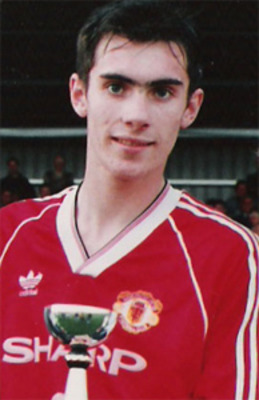
Around this time, Cooke was pictured with his fellow youngsters alongside the Youth Team Coach Eric Harrison as he received some order - but it was a shortlived spell in the limelight for the West Midlands lad. As a right winger, he wasn't in the same league as David Beckham (not asking much!) and in the summer of 1996, other players were signed who could play that position and a series of loan spells followed over the next couple of years.
One of these proved to be successful, when he joined a Manchester City side then in freefall, dropping as far as the third tier - some of their nu-fans attracted to their current powerful side may struggle to believe only 15 years ago they were playing the likes of Macclesfield Town. Struggling to adapt to life far from the top, Cooke seemed to be something of a catalyst, scoring five goals in 17 games to secure a permanent transfer and help push them into the promotion play-offs. In the dramatic final of those against Gillingham, in which only a last-gasp Paul Dikov equalising goal saved them from disaster, Cooke slotted away a penalty in the shoot-out that helped City to victory.
That was probably the peak of Cooke's career. The following saw him suddenly fall out of fashion with City manager Joe Royle (it was rumoured that his not being picked was due to the club not being able to afford the additional fees to United that would be incurred if he hit a certain number of appearances) and he again found himself down the rounds as a loaned-out player before a free transfer in 2001.
He later went on a globe-trotting serious of career moves, with spells in North America, Australia and Azerbaijan before injury forced his retirement in 2011.
Sunday, 16 February 2014
62. Phil Neville
Signed from: Youth team
Debut: 5-2 win vs Wrexham (FA Cup tie), January 28th 1995
League Record: 210 games (+53 as sub), 5 goals
Sold to: Everton (£3,500,000), August 2005
Younger brother of Gary, Phil was also considered to be a talented cricketer in his youth, but chose United when they came knocking. Their sister Tracey was also talented, playing netball for England. Phil made his debut in the season Gary established himself at right back as injuries did for Paul Parker - also captaining the youth team to FA Youth Cup success that same year.
The next season, he made some fine performances at left back (Dennis Irwin shifting to the right), knocking Gary out of the first team at times. Indeed, for the FA Cup final against Liverpool in 1996, Phil got the nod ahead of his brother, who had to make do with being a sub – he’d looked impressive through the season, putting in some good crosses when he got forward.
To cap off a superb first full season, he won his first England cap and made the squad for the 1996 European Championships. However, Gary remained first choice at international level and Phil never quite managed to establish a regular spot, being left out of the World Cup 22 in 1998 and 2002, though he made the squads for both the 2000 and 2004 Euros – at the former, a rash challenge in a decisive game against Romania saw a penalty awarded and converted, effectively knocking England out and condemning Neville to much venting of bile over the subsequent year from opposition fans back at domestic level.
As an aside, at the time, a few people said I looked like Phil, thus it was something of a knock to a teenager's confidence on reading a newspaper report which labelled my apparent lookalike as the "Ugliest Player at Euro 2000".
For United, he never quite managed to maintain the high levels he set early on, remaining a solid presence in the squad, capable of covering either full back position and, later on, putting in a shift in midfield when needed. It was in that role he had his finest moment in a red shirt.
In December 2002, we were chasing an Arsenal team that were looking to establish dominance in the league. They were the reigning champions and FA Cup holders, boasting an impressive midfield led by French international Patrick Vieira. With the chips down, Phil seemed to dig up the spirit of Bryan Robson and dominated a game in which we won 2-0 - a performance still talked about by fans.
However, in the next couple of years, Fergie made a series of nightmare midfield buys, of whom he felt obliged to play, and both Phil and Nicky Butt were out of action. Clearly good enough to have a first team stake elsewhere, he reluctantly asked for a transfer. I was disappointed at the time, as he certainly deserved more games and his attitude and commitment were solely lacking in others players around at the time.
On finally leaving, he became a deserved first choice (and captain) at Everton and it’s a surprise to me that he didn’t feature more for England. Then, in June 2013, he returned to United as first team coach under the new regime of David Moyes.
Friday, 31 January 2014
61. Andy Cole
Signed from: Newcastle United (£6,000,000 plus Keith Gillespie)
Debut: 1-0 win vs Blackburn Rovers, January 22nd 1995
League Record: 161 games (+34 as sub), 93 goals
Sold to: Blackburn Rovers (£8,000,000), December 2001
Ah, the days when a huge signing could appear out of nowhere and shock you. The news that Andy Cole was on his way to United was exciting to a youthful United – at the time, he was the reigning Young Player of the Year as well as the previous season’s Premiership top scorer. The prospect of him lining up with Eric Cantona seemed to promise goals galore. It didn’t quite work out that way.
Nottingham lad Cole, son of a miner, started out with Arsenal, then managed by George Graham. The dour Scot clashed with the youngster, and after only a single showing from the bench, he was on the way to Bristol City via a loan spell at Fulham. His first full season as a first teamer (92/93) saw him in good form in the second tier, and he attracted the attention of Kevin Keegan, then revitalising Newcastle United and charging to a return to the top flight. February 1993 saw £1.75 million change hands, and he instantly won hero status with 12 goals in 12 games.
Keegan then made an inspired move by bringing Peter Beardsley back to the North East. Having started out in my native Cumbria with Carlisle United, Peter had caught the eye of the legendary Jimmy Murphy whilst playing in Canada for Vancouver Whitecaps. Murphy had always had a keen eye for talent (he had recommended Steve Coppell) and we signed him for £250,000 in 1982. Then manager Ron Atkinson failed to give the striker much of a chance – half a game against Bournemouth in the League up – and let him go at the end of the season. While Beardsley developed into one of the best forwards in the country, we spent years attempting to find a decent forward line: the likes of Garth Crooks, Alan Brazil, Terry Gibson and Peter Davenport all failing to make the grade. It was, quite simply, Atkinson’s worst mistake as manager for us.
By 1993, perhaps Everton saw Beardsley as past his best – he was 32 at the time – but he and Cole scored 55 league goals over the season, as Newcastle won many fans with their attacking football. Andy got 34 of those, and though he was in slightly slower form the next season (nine goals in 18), Alex Ferguson was still convinced he was the man to replace the aging Mark Hughes in leading the front line.
Andy was never a complete crowd favourite – he had many detractors, including my own dad, who never rated him. Conversely, my mother adopted him as her favourite player, perhaps because he had learned his trade alongside her former favourite Beardsley.
A lot of his problems came on the last league game of the 1994/95 season, away at West Ham. Andy had had his moments early on – five goals in a game against Ipswich was the best one-off haul for a United player since George Best put six past Northampton in 1970, and he scored two vital goals in a 3-2 win over Coventry that kept us in the title race. At West Ham, though, he saw chances saved and hit a post as we only drew 1-1, when a win would have made us champions.
Cole, unfairly, took a lot of the blame. He struggled to reach his best form over the next two seasons – his partnership with Eric never really took off, and he wasn’t helped by a broken leg in the Autumn of 1996. Fergie seemed to be losing patience, as he signed three new strikers from 1996-98, one of whom Cole had already fallen out with over a perceived slight whilst on England duty.
The last of those three, however, brought Cole back to the forefront. Finally connecting with a strike partner, period from 1999-2000 saw him play the best football of his career. No long a pure goalscorer, his all round play had improved to an impressive degree. He scored the goal that sealed the 1999 Championship, as well as the winner at Juventus that saw us seal our place in the European Cup final.
By 2001, however, injuries had begun to take their toll - he played just 19 league games in 2000-01 season - and Fergie spent big on a new striker and adjusted the system so that we played with just the one man up top. With his first team regular status no longer assured, and still hopeful (incorrectly, as it turned out) of getting in the place in the England squad for the 2002 World Cup, he left for Blackburn. He had some success, completing his set of domestic medals by scoring the winning goal in that year season’s League Cup final.
Season-long spells at Fulham and Manchester City followed, making a decent scoring return at both, before his career wound down, ending with an unsuccessful stint back in his hometown with Nottingham Forest. Currently, he works as a television pundit and comes across far more articulacy than he did in his younger days.
Monday, 27 January 2014
60. Kevin Pilkington
Signed from: Youth team
Debut: 3-0 win vs Crystal Palace (as sub), November 19th 1994
League Record: four games (+2 as sub)
Sold to: Port Vale (free transfer), Summer of 1998
As a goalkeeper, Kevin was always going to struggle to break into the first team when the man already there was the best in the world, while Gary Walsh was a more than capable deputy.
Despite that, he did manage some game time due to injuries and didn’t embarrass himself. Having experienced players like Bruce and Pallister ahead of him doubtless helped – the two of them must have been pleased in part to not have a giant Dane barking abuse at them for 90 minutes.
Sadly for Kevin, his most prominent moment in the shirt came when Schmeichel got injured at Tottenham – Kevin was thrown in to a line up already struck by injuries, and Spurs took advantage to record a 4-1 victory. The arrival of the veteran Tony Coton pushed him back into the reserves and he went through several loan spells to gain experience (he didn't appear to do too well at Rochdale), as well as putting him in the shop window.
Port Vale was the first stop on a varied career in the lower tiers, most notably with Mansfield Town and Notts County. At the latter, he lost his first team place to Kasper Schmeichel – son of Peter. Some families just have a habit of fucking up a guy’s life. All the same, the best part of 400 league means that while he didn’t enjoy the successes of Neville, Scholes and Beckham, he still managed better than O’Kane, Davies and Casper. Most recently, he's back at Notts County as their goalkeeping coach.
Kevin is also the last of the “Class of ‘92” to appear in this list. The only other notable “graduate” would be Robbie Savage, who after being released on a free transfer without making the first team, would carve a good career out for himself with Crewe, Leicester City, Blackburn and Birmingham, as well as being a regular for the Welsh national team.
Friday, 24 January 2014
59. Graeme Tomlinson
Signed from: Bradford City (£100,000), Summer of 1993
Debut: 2-0 win vs Port Vale (League Cup tie), October 5th 1994
League Record: no league appearences, two as sub in the League Cup
Sold to: free transfer to Macclesfield Town, Summer of 1998
My only memories of Graeme are of reading about his arrival in the official club magazine, of which I still have every copy from the first (in December 1992) to around 2004. I say “I” still have them – the vast majority are currently going very mouldy in my parents’ attic.
Tomlinson was an early case of Fergie importing young talent (insert your own joke there), a practise a lot more common today. He’d impressed in a Youth Cup tie, and had even scored a few for the Bradford first team. He first got into the team a year after he signed, in the second leg of the (in)famous Port Vale League Cup tie, following it up with another showing from the sub's bench in the next round, where we put up a decent showing against Newcastle, losing 2-0 at St James' Park.
Sadly, a bad injury whilst out on loan stopped him making any real progress, robbing him of a lot whatever Fergie has seen in him in the first place. Given a free transfer, he drifted to Macclesfield and Exeter, never finding any goalscoring form, before leaving the professional game.
Thursday, 23 January 2014
58. Chris Casper
Signed from: Youth team
Debut: 2-0 win vs Port Vale (League Cup tie), October 5th 1994
League Record: two games, both as sub
Sold to: Reading (£300,000), November 1998
Son of 1970s Burnley forward Frank, Chris Casper was another who made a handful of showings over a number of years. Like John O’Kane, as a defender, there was too many quality players ahead of him for there to be a realistic chance of making the first team on a regular basis.
It was the best part of two years after his debut that he got in the team again, making appearances in all the cup competitions as well as his two showings from the bench in the League. Loan spells followed, the last of which was at Reading, where he was impressive enough for them to shell out the cash.
It seemed to be working out until a horrific leg injury ended his career aged only 24. Moving into coaching, he eventually became manager of Bury while only aged 30. A two-and-a-half year spell in charge (relatively a long term by modern standards!) came to an end in January 2008. More recently, he's worked with club's Academy systems for the Premier League.
Wednesday, 22 January 2014
57. John O’Kane
Signed from: Youth team
Debut: 2-1 win vs Port Vale (League Cup tie), September 21st 1994
League Record: one game (plus one as sub)
Sold to: Everton (£400,000), January 1998
As a full-back, John O'Kane (seen fourth from left on the back row of the picture above) had little to no chance of becoming a regular when we had Irwin, May and the Neville brothers around. An opening day injury crisis saw him a sub in the opening game of the 1995/96 season, where our 3-1 defeat was met with the now infamous line from Alan Hansen that "you never win anything with kids".
To give Hansen some mitigation, United's subsequent success that season was only in part down to the youth of Beckham, Scholes, Butt and the Nevilles. They were surrounded by experienced quality players like Cantona, Schmeichel, Irwin, Bruce and Pallister. Even the likes of Keane and Giggs (then in their mid 20s) had the best part of 150-200 games each under their belts. We were hardly a team of "kids" at the time.
As for O'Kane, he must have felt confident when Everton signed him up after a series of loan spells at Bury and Bradford, but he struggled to make an impression and the he moved progressively downwards with moves to Bolton, Blackpool and then non-league Hyde United. Like Simon Davies, he perhaps left it too late to leave United - he was nearly 24 when he did so.
After a three year stint with Hyde, he eventually returned to his native Nottingham, where he has been doing support work in social care.
56. Simon Davies
Signed from: Youth team
Debut: 2-1 win vs Port Vale (League Cup tie), September 21st 1994
League Record: four games (plus seven as sub)
Sold to: Luton Town, for £150,000, August 1997
Looking back, it’s almost staggering how many young players Fergie give a chance to in the mid 1990s, and for all those that made it (such as our previous entry), plenty more don’t and end up sliding down the divisions.
At least Simon Davies got a decent chance, and even scored a goal in a 4-0 win over Galatassary that was sadly something of a dead rubber – qualification to the knockout stages of the Champions League had become impossible by that point. Davies wasn’t awful, but never looked like he was going to challenge Ryan Giggs’ spot on the left wing. Despite only one League start in 1995/96, he still managed to win a cap for Wales.
In the summer of 1996, Fergie went on a spending spree and Davies moved further down the pecking order. In truth, Simon would have benefited from leaving then, as he spent the subsequent season with only sub appearences in League Cup ties to show for it, and doubtless this caused some stagnation.
A transfer to Luton Town failed to bring any revival in his fortunes and his career never picked up again. Mike MCSG offers a perspective on his time at Rochdale here. Following that, he spent three years in the Welsh league.
As of January 2014, he is working on the other side of town for City’s under 21 side.
Tuesday, 21 January 2014
55. Paul Scholes
Signed from: Youth team
Debut: 2-1 win vs Port Vale (League Cup tie, scored twice), September 21st 1994
League Record: 404 games (+95 as sub), 107 goals
Sold to: Retired in the Summer of 2013
Ah, how we can laugh now. Youngsters may not know of the hoo-ha surrounding the debut of Paul Scholes: Fergie essentially decided to use the League Cup to blood younger players, in part due to the fact we had, in 1994/95, qualified for the Champions League group stage for the first time. This meant six extra games for the first teamers, though the “three foreigner” rule meant our first foray led to embarrassment in Barcelona and Gothenburg.
Therefore, with the first team stretched, the League Cup was what give way and the Boss decided to use it blood younger players. At the time, pundits moaned about United “cheating the paying fans” but in hindsight, how many of those that paid for the first Port Vale game boast about seeing the debut of the finest English player of his generation?
Short, asthmatic and (as a youth) topped with a crop of bright ginger hair, if Paul Scholes looked like a footballer it was more in the midfield-terrier style of a previous North Manchester-born legend - Nobby Stiles. However, “the Ginger Prince” was born with an uncanny football brain that gifted him a superb range of passing and an ability to time his runs into the box to score vital goals. As for tackling… well, everyone has their kryptonite.
Initially playing as a centre-forward, by 1997, he had moved back to the centre midfield role, his superb range of passing and vision becoming a crucial part of our play. By 1999, Scholes and Roy Keane were doubtless the best midfield combination in the country and drove United to the Champions League final – Paul scoring a vital goal at the San Siro to get us past Inter Milan in the Quarter Finals. Bookings in the Semis against Juventus saw both miss out on the final, but Scholesy would finally get his medal nine years later, sealing our path to the final with a winning goal against Barcelona.
On the international stage, he was initially a success – Kevin Keegan was a huge fan. However, by the start of the new century, the pressure to play a system that featured Steven Gerrard and Frank Lampard (both of whom enjoyed the limelight) saw our man shunted out to the left wing by Sven-Goran Erikkson. It was a joke of a compromise, albeit one opposition teams were thankful for, seeing as it put England’s most dangerous player in a relatively harmless position. After the 2004 European Championships, he’d had enough and asked to not be considered for selection again. There was calls for him to be brought back for the 2010 World Cup, and Fabio Cappello was apparently keen, but Scholes decided he’d rather spend the summer at home in Oldham.
Though initially retiring in the summer of 2011, he came back in January 2012, a decision which would prove decisive to one young Frenchman who felt his deserved his chance in the first team and wasn’t happy to see the veteran get there instead. He played a final season, though his powers were clearly very much on the wane, before quitting for good at the end of 2012/13, another Championship medal in the bag.
It was a privilege to have seen the man play football.
Sunday, 18 November 2012
54. David May
Signed from: Blackburn Rovers (£1,200,000), July 1994
Debut: 2-0 win vs Queens Park Rangers, August 20th 1994
League Record: 68 games (+17 as sub), 6 goals
Sold to: Burnley (free transfer), summer 2003
With Steve Bruce well into his mid 30s, Ferguson’s first attempt to find a replacement at centre back was David May.
Like Brucie, May was an uncomplicated player. As a child, he’d supported Manchester City and went for a trials. However, he felt their approach to young players wasn't for him, and he headed North to the more homely Blackburn Rovers, at the time going nowhere fast in the old Second Division. By the time local businessman Jack Walker’s millions had pushed them into the top flight in 1992, May was established alongside ex-United star Kevin Moran at the back and they finished runners-up to us in 1993/94.
All the same, it was still a surprise (to me, at least) when he was given the chance to return to Manchester. Initially played at right back, he lost out to the emergence of Gary Neville and he didn't become a regular starter until 1996/97, after Bruce had wandered off to Birmingham City. To his credit, May was in fine form, chipping in with the odd goal and getting a call up to the England squad.
However, injuries then cost him a first team place, and he was pushed further out by the signings of further defenders with a more sophisticated style than May’s typically English blood-and-guts approach. In the treble season, he barely featured at all until the last few weeks, where (to his credit) he came in and did a steady job. To save players for the Champions League final, he started in the FA Cup final and helped us to a easy 2-0 win over Newcastle.
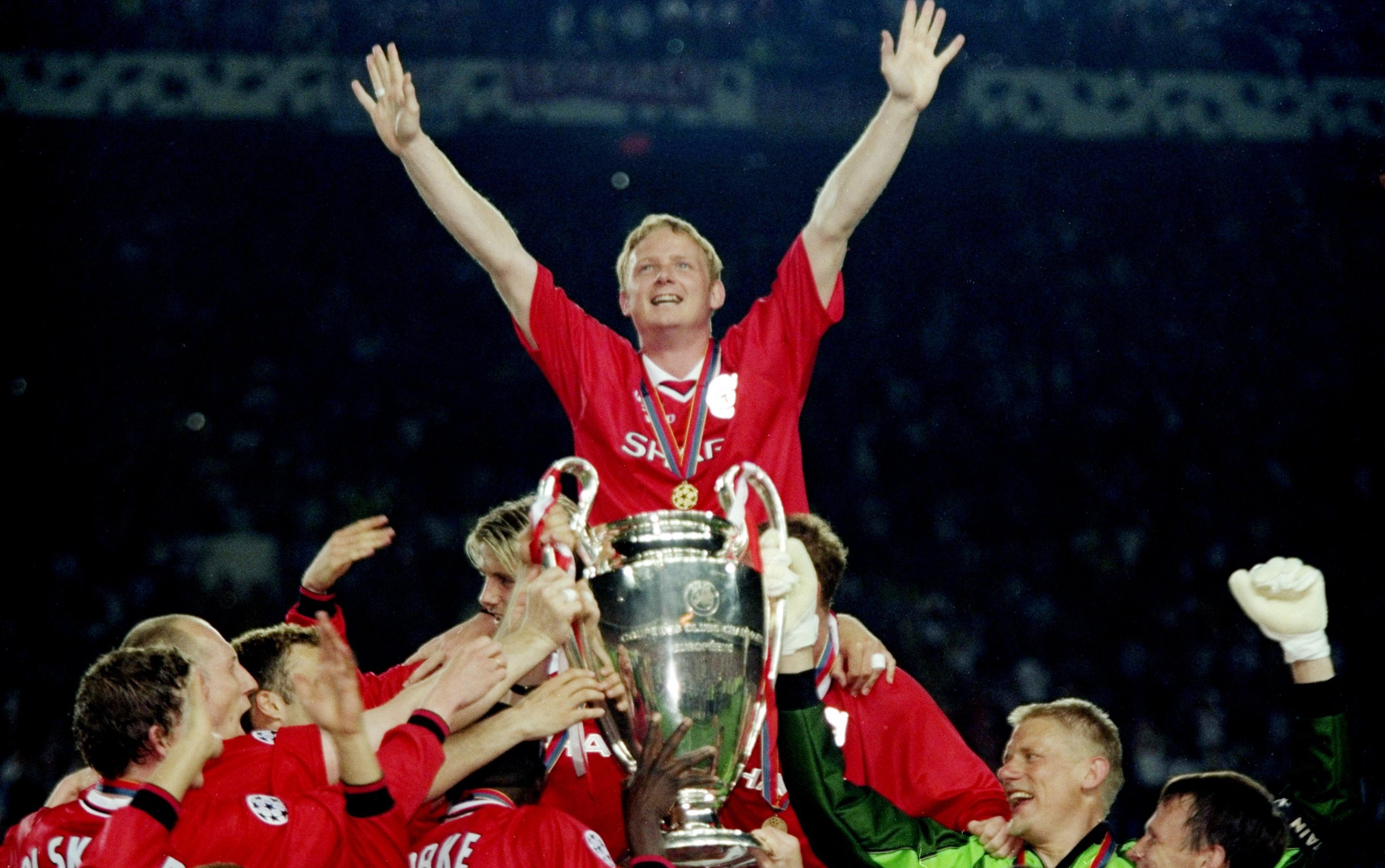
He was, apparently, under consideration to start the CL final due to suspensions to others, but in the end only made the bench, which resulted in him picking up a medal despite not playing any European football that season. His lasting legacy remains his crafty positioning of himself in the pictures of celebrations from this game (see above), and that season ensured United fans had the chant “David May, superstar/got more medals than Shearer” – two league championships, two FA Cups and a Champions League medal, for the record.
After that, he was restricted to no more than a couple of showings a season due to a series of injuries. By the time he was finally shunted out to Burnley, he was 33 and had been kept around a bit too long. By all accounts, something of a Jack the Lad in his younger days, he currently co-hosts a show on MUTV.
Debut: 2-0 win vs Queens Park Rangers, August 20th 1994
League Record: 68 games (+17 as sub), 6 goals
Sold to: Burnley (free transfer), summer 2003
With Steve Bruce well into his mid 30s, Ferguson’s first attempt to find a replacement at centre back was David May.
Like Brucie, May was an uncomplicated player. As a child, he’d supported Manchester City and went for a trials. However, he felt their approach to young players wasn't for him, and he headed North to the more homely Blackburn Rovers, at the time going nowhere fast in the old Second Division. By the time local businessman Jack Walker’s millions had pushed them into the top flight in 1992, May was established alongside ex-United star Kevin Moran at the back and they finished runners-up to us in 1993/94.
All the same, it was still a surprise (to me, at least) when he was given the chance to return to Manchester. Initially played at right back, he lost out to the emergence of Gary Neville and he didn't become a regular starter until 1996/97, after Bruce had wandered off to Birmingham City. To his credit, May was in fine form, chipping in with the odd goal and getting a call up to the England squad.
However, injuries then cost him a first team place, and he was pushed further out by the signings of further defenders with a more sophisticated style than May’s typically English blood-and-guts approach. In the treble season, he barely featured at all until the last few weeks, where (to his credit) he came in and did a steady job. To save players for the Champions League final, he started in the FA Cup final and helped us to a easy 2-0 win over Newcastle.
He was, apparently, under consideration to start the CL final due to suspensions to others, but in the end only made the bench, which resulted in him picking up a medal despite not playing any European football that season. His lasting legacy remains his crafty positioning of himself in the pictures of celebrations from this game (see above), and that season ensured United fans had the chant “David May, superstar/got more medals than Shearer” – two league championships, two FA Cups and a Champions League medal, for the record.
After that, he was restricted to no more than a couple of showings a season due to a series of injuries. By the time he was finally shunted out to Burnley, he was 33 and had been kept around a bit too long. By all accounts, something of a Jack the Lad in his younger days, he currently co-hosts a show on MUTV.
Wednesday, 14 November 2012
53. Colin McKee
Signed from: Youth team
Debut: 0-0 draw vs Coventry City, May 8th 1994
League Record: That was his only game.
Sold to: Kilmarnock (with Neil Whitworth for a combined £350,000), September 1994
Not much to say about Colin - I certainly don't remember him as anything but a regular scorer for the reserves.
He got his one run out in an end of season dead rubber notable only for being the last time Bryan Robson played at Old Trafford. Returning to his native Scotland, a three year spell at Kilmarnock was followed by a series of short-term spells at several small Scottish clubs, never playing more than a handful of games at any, and he retired from the game in 2001.
52. Ben Thornley
Signed from: youth team
Debut: 2-2 draw vs West Ham United (as sub), February 26th 1994League Record: One game (+8 as sub)
Sold to: Huddersfield Town (free transfer), May 1998
The first (but certainly not the last) of the “Class of 1992” to appear here who didn’t end up with lengthy career at United, Ben Thornley picked up many positive notices, but was never helped by the fact he played left wing – a position more than aptly covered by Ryan Giggs and Lee Sharpe.
His chances dived even further when his leg was broken not long after his debut in a reserve game against Blackburn - he later sued the other player involved, a matter settled out of court. That pretty much ended any real progression, though the fact he was still in the squad as late as 1998 would suggest Fergie had some faith in him working out. But it was not to be, and he was packed off to Huddersfield Town. Though the team looked an outside bet for the Premier League at one point, they were instead relegated in 2001 and Thornley left to play over the border for Aberdeen. From there, it was a disappointing slide into the lower divisions and eventually the non-league, leaving us with a sad sense of a talent lost through matters out of the player's control.
Apropos of nothing, his brother has worked as a masseur to the England national team.
Sunday, 11 November 2012
51. Roy Keane
Signed from: Nottingham Forest (£3,750,000),
Debut: 2-0 win vs Norwich City, August 15th 1993.
League Record: 309 games (+17 as sub), 33 goals
Sold to: contract terminated (November 2005), subsequently signed for Celtic
A legend, though he probably wouldn't like me saying that. With Bryan Robson finally approaching the end of the road, we signed possibly the only man capable to taking over the same role. I'm not sure anybody in this list will come close to the levels Roy Keane strived to achieve his goals on the field: he didn't care about making friends or being liked by anyone – all that mattered was victory.
Despite the fact he would eventually become one of the most highly-regarded players in world football, young Roy was a late starter. At 19, he was still playing in his native Cork before Brian Clough brought him over to Nottingham Forest. Months later, he played in the 1991 FA Cup final, though ended up on the losing side.
By 1993, though, Clough had lost his battle with the bottle and Forest were relegated. Keane was ambitious and wanted to be playing at the highest level: Blackburn (at that time) matched that level of ambition and he looked nailed on to join them until a last-minute Fergie swoop saw him come to the right side of the A666. His joining us would be immortalised in the terrace classic ‘Keano’s Magic Hat’.
With the departure of Paul Ince in 1995, Keano was free to establish total dominance of the midfield, a position he would maintain for the best part of a decade, and when Eric retired in 1997, he took over the captaincy too. In this role, he took a more traditional approach – offering bollocings to teammates when they were needed and inspiring through sheer drive and energy.
His importance to the team was reflected in his first season as skipper, when a serious long-term injury resulted in a serious tilt at the title running out of steam. He came back the next year stronger and hungrier for missing out - leading to his greatest moment in a red shirt.
It was the 1999 Champions League semi-final against Juventus, who at that time had stars like Davids, Zidane and Del Piero at the top of their game. The first leg at Old Trafford had ended 1-1 and within no time at their place, we were 2-0 down and looking dead. Keano had had enough, took charge and scored the first goal in our 3-2 comeback. What made this more remarkable was that he picked up a booking that meant he would miss the final, but instead of moping, he played harder and better than ever.
The attitude and commitment that saw him win so much at United also led to one of his most infamous moments, when prior to the 2002 World Cup, he criticised the training facilities organised for the Irish team. Convinced management saw the whole affair as little more than a jolly, he stormed out after a bust-up with manager Mick McCarthy. Around the same time, he criticised sections of the United support of just turning up for the experience and not getting behind the team. A lot of the traditional fanbase found it hard to argue.
Three years later, his forthright views got him in trouble again. After we took a 4-1 kicking at Middlesbrough, he went on the in-house TV channel and laid into various players, not holding back one bit. Ferguson found this unacceptable and the subsequent rift between the two led to his leaving the club. To give Keane his dues, everything he said was spot on and he later stated he went to each player he criticised and explained why he said what he had. Though he was past his peak at the time, he was still the captain and a major influence on the team and we've not had that kind of box-to-box midfielder since.
Following managerial spells at Sunderland (mixed fortunes) and Ipswich Town (not good), he’s currently seen as a pundit for ITV’s coverage of England and Champions League games, where he’s often amusing with his usual straight talking.
Monday, 5 November 2012
50. Keith Gillespie
Signed from: Youth team
Debut: 2-0 win vs Bury (FA Cup tie), January 5th 1993. Scored onceLeague Record: Three games (+6 as sub), one goal
Sold to: Newcastle United (valued at £1,000,000 in an exchange deal), January 1995
Direct winger in the old fashioned tradition (i.e. he kept running at the full back, putting a cross in on the occasions he beat his man), Keith Gillespie scored on his debut and two years later got his only Premiership goal with a fine effort against Newcastle. They were obviously impressed as not long later he was playing for them.
I personally had high hopes for Gillespie and was disappointed to see him leave, more so when we sold Andrei Kanchelskis a few months later, as I'd not seen enough of David Beckham at that point to know he was more than capable of holding the right wing. What is interesting to wonder is that if Keith hadn't left United, whether he’d have got the chance on the right wing that was given to Beckham and making the late 90s a very different tale. Certainly his valuation of a million pounds was very high for a (relative) novice in 1995, and shows how much faith Keegan had in him.
He went on to have a fairly successful career in Geordieland and then Blackburn, where he teamed up with Mark Hughes, as well as being a regular for Northern Ireland. His last significant role was at Sheffield United, where he helped them gain promotion to the Premiership in 2006. While up there, he managed to get sent off within seconds of coming on as a sub, for elbowing an opposition player in the face while he ran into position. Bizarre.
Still playing in the League of Ireland as of 2012.
Sunday, 4 November 2012
49. Eric Cantona
Signed from: Leeds United (£1,200,000), November 1992
Debut: 2-1 win vs Manchester City (as sub), December 6th 1992
League Record: 142 games (+1 as sub), 64 goals
Sold to: Retired, summer of 1997
The beginning of time, for this fan. Recently, one Red Issue columnist commented on one of our current players praying before kick off by saying "there’s only one God round here, and his name is Eric". Damn right.
It’s strange to think that in early 1992, Eric Cantona was almost washed up. Though a French international, his temper had alienated him from several clubs in his homeland. Insulted by Sheffield Wednesday manager Trevor Francis’ request for a “trial”, he instead went to Leeds United, playing a minor (though subsequently exaggerated) role in their 1992 title win.
The Yorkshire fans took to Eric quickly – perhaps enjoying a bit of exotic flair alongside the likes of Lee Chapman and Chris Fairclough. He began the next season with a bang, scoring a hat trick in the Charity Shield against Liverpool and another triple (the first in the Premier League) against Spurs. But all was not well – Cantona’s individualism not mixing well with the rigid long ball game favoured by Howard Wilkinson.
Then came a fateful phone call in December 1992. Leeds contacted United about buying Denis Irwin (laughable, given they let him go for nothing in 1986), an obvious non-starter. However, either Alex Ferguson or United chairman Martin Edwards asked about Cantona – the word came back a deal might be on, and in quick time, United had a new forward.
His impact was close to instant. At the time, we were struggling in the league, not scoring enough goals and looking like the failure to clinch the title the year before has sucked the fight from the players. Eric came along and galvanised everything. Linking well with Mark Hughes, he was given the chance to express himself with a freedom denied to him before. It's not an exaggeration to say things clicked almost overnight, as we won eight of the ten games following his debut.
More importantly, Manchester welcomed the man with open arms and he felt right at home. United fans recognise genius when we see it, and in Eric we knew we had someone with that ability to do the complete unexpected, a player to make you gasp in a way we hadn't seen since for some years. So highly did we (still do) value him, that he became "The King", a title only given once before, to Denis Law. As much as his ability was his attitude - one of his team-mates described him as "collar turned up, back straight, chest stuck out, he glided into the arena as if he owned the fucking place". He was unlike most footballers, living in a modest semi-detached house, taking an interest in art and cinema and capable of conversations beyond the usual "over the moon" variety.
In the 1993/94 season, he got even better, scoring vital goals as we held onto the title and won the FA Cup as well - Eric scoring two penalties in our 4-0 smashing of Chelsea. Our team that season has gone down in some legend to representing the peak of attacking football in the Fergie years: with Giggs, Sharpe and Kanchelskis running riot on the wings, both scoring and providing many goals.
The next year seemed to be more of the same, until the famous night at Selhurst Park, when after being the subject of rough treatment from Crystal Palace defender Richard Shaw, Eric lashed out and was sent off by the referee. Trudging off the field, a Palace fan elected to charge down the stand shouting abuse only to be met with a flying kick from the King. For this, he was banned for nine months and United's season resulted in zilch.
It was a strange time for us, and when Hughes, Ince and Kanchelskis were sold off that summer, some of us questioned Alex Ferguson's sanity. What we also didn't know at the time was that Eric was feeling fed up and almost ready to quit: it took a visit from Fergie to Paris to convince him to return to Manchester.
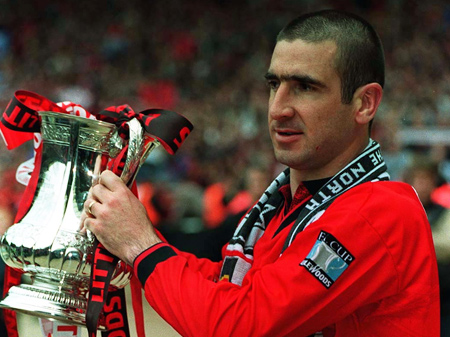
And how glad we would be that he did. Made captain of a team where the likes of Gary Neville, Nicky Butt and David Beckham were now regulars, he was a strong influence and led from example: at the climax of the campaign we had a run where we seemed to win most games 1-0 with the goal from Eric. He repeated this trick in the cup final, slamming in a late winner against Liverpool in a moment that won't be forgotten by reds anywhere.
The next season, though we won the league again, he didn't seem quite himself. Perhaps at 31, he realised he wasn't at his peak anymore. His retirement that summer was a huge shock, but in hindsight I can only respect his decision. He'd fallen out of love with the game and wanted to go do all other things with his life. In four and a half years, he'd helped turn a club of under-achievers into the most dominant club in England. There have been players before and after who have had more talent, but very few have won the hearts of the fans as much as Eric.
Nowadays, he’s continuing to develop his acting skills on stage and screen (including the brilliant Looking For Eric) and working towards getting New York Cosmos back off the ground. And he’s still the sexiest fucker who walks the Earth.
Subscribe to:
Posts (Atom)